Great Britain Rifle Team

South Africa 2023

Bloemfontein, South Africa

Women in Target Rifle

By Paul Sykes
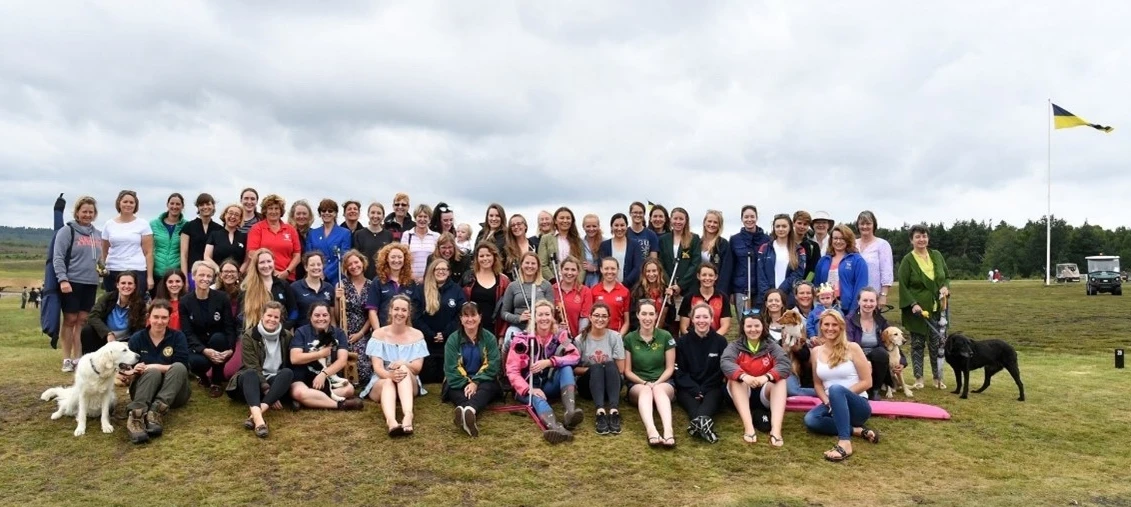
2023 GB Rifle Team member Rosanne Furniss looks at the role of women in target rifle shooting and how recent progress can be embedded into its future to benefit us all

Fullbore target rifle shooting is one of the few sports where men and women can compete on an equal basis. We see multiple examples of women competing at the highest level in open competitions, including Commonwealth Games and World Championships.

Yet, in the UK, the latest Home Office statistics show that men account for 97% of the 151,000 firearms certificate (FAC) holders, with only 5,180 women holding an FAC. Perhaps unsurprisingly, less than 5% of all Great Britain caps in the Target Rifle (TR), Match Rifle (MR) and F-Class disciplines have been awarded to women.

Women in international target shooting

Historical records suggest opportunities for women to progress to the highest competitive levels have grown significantly in recent decades. Of the 45 women ever to have represented Great Britain in rifle shooting, 36 were awarded their first caps between 1990 and 2022. But the proportion of female entrants in large, open competitions in the UK significantly exceeds those who make it to the highest competitive level of team shooting.

Trailblazers such as Marjorie Foster (first capped for GB in 1949), Jean Orpen-Smellie (1966) and Carol Painting (1968) opened the door for female competitors at the highest international level. Jane Messer was the first woman to be awarded the prestigious ‘Big 5’ badge in 1995. Jane was also the first woman to represent GB in the Palma Match in 1992, followed by Sarah Kent (1995), Marijcke Veltman-Grisenthwaite (1999), Alice Ogilvie and Alex Pilgrim (both in 2003).

In 1997 there were 5 female members of the GB Cadet team (the Athelings). 3 of those, Emma Cannings, Erica McMullan and Jacqui McQuillan (nee Rankin) then undertook international leadership roles as GB Under 25 Captain or, in Emma’s case, as Commandant to the 2008 GB Under 19 Team to South Africa.

In 2000, Dorothy Dallas (nee Hume) captained the GB Under 25 team to South Africa with Mary Boston as her Adjutant. Later that year Jo Hossack won HM the Queen’s Prize at Bisley, becoming the second female and youngest ever winner.

In 2010, LouLou Brister became the first female captain of the GB Match Rifle Team and continues to lead the Welsh Match Rifle Team. In 2015, Jane Messer captained the GB Palma Team for the World Championships at Camp Perry, USA. The team delivered a world record score.

In the 2022 season we saw perhaps the most significant in a series of breakthrough years for women in the Target Rifle discipline. Chloe Evans and Rosanne Furniss shot for Great Britain in the Kolapore Match. Alice Good won HM the Queen’s Prize, becoming only the third female winner (GM). Female competitors took 7 of the top 50 places in the Grand Aggregate, won the first stage of HM the Queen’s Prize and finished 2nd and 3rd in the St George’s. In October, Lucinda Taylor was crowned European Long-Range Individual Champion.

This pipeline of highly talented women appears stronger than ever, with five female members of the 2023 GB squad to South Africa. In 2024, GB’s captain for the Under 25 World Championships in South Africa will be Harriet Bramwell and over a third of the Under 21 and Under 25 squads are female.

We could, and should, be doing more to celebrate these successes.

So, things are heading in the right direction but what can we do to improve it further?

There are multiple examples of national sporting governing bodies creating impactful strategic initiatives to improve participation rates across all competitive levels. For example, the British Triathlon outreach programme and the South African Rugby Union quota system, to name but two. Whether or not our governing body will prioritise the allocation of resources to build and deliver such initiatives, including support for the elite competitive end, remains to be seen. If we want to accelerate our progress let’s assume we will need to self-organise. There are a few key themes that we could explore:

Community and Networks

If you speak to the women who have taken up the sport and continued in it, they have often had support from those around them, whether family or friends.

When I started competitive shooting in 2006 I took up Match Rifle and Target Rifle. I managed to get in the top 200 of the Grand Aggregate twice in three years but I was not on anyone’s radar as someone who might want to continue Target Rifle shooting. This was different to Match Rifle – with a smaller field of entrants, I was welcomed, and was able to learn the names of several shooters, building friendships outside of the student group I was part of. Support from successful women in the sport like Silke Lohmann provided a network that encouraged friendships and celebrations of success, that has continued with the International Match Rifle Ladies – an amazing opportunity to introduce more women to team shooting each year. It’s no coincidence that for 10 years, Match Rifle was the only fullbore shooting I did.

Opportunity

When I shot my first Elcho match in 2009 (as the first woman to shoot for England in the Elcho), the Match Rifle community was welcoming and supportive. It hadn’t mattered how new I was to shooting. England’s captain, Nick Tremlett, was very conscious of providing fair opportunities for any shooters who were performing well.
How many women or other underrepresented groups miss out on opportunities because much of our sport still relies on who you know? If you weren’t lucky enough to go to a ‘shooting school’ or be part of a cadet team that offered shooting, how do you get to know where to get a rifle, which clubs are the best value, how to get to know the various clubhouses at Bisley or who the captains of the teams are? This is a huge opportunity for all of us to build upon.
In particular, transparent application and selection processes can only benefit the majority of team applicants and provide support to Team Captains. Meritocracy at the highest level will aid the longevity of our sport.
This isn’t all just for the benefit of the women who may make the top teams; there is lots of evidence of the benefits to outcomes of more diverse teams. Sports psychologists identify improved outcomes in mixed teams due to a wider range of responses to stressors. The ‘Tend-and-Befriend’ alternative to the Fight-or-Flight response skews heavily towards females and can support greater resilience to stressful situations. Anyone who has shot in a match for their country will know it can be stressful.

Understanding and embracing differences

With fewer women around the shooting world, some of the strengths that can be stereotypically associated with women can be undervalued. Equally, the benefits of some male-orientated traits can be overemphasised. For instance, creating an environment where a few tears are normal should be normal! Diverse teams will improve overall outcomes in those circumstances.

Societally, differences between men and women (Invisible Women is a great read for anyone who likes data) are better understood than ever before. For instance, the effects of the menstrual cycle on sporting performance is now better understood. Studies have shown that hormonal fluctuations during the menstrual cycle can impact training and performance capacity. As research progresses it will be important to consider how this effects more diverse teams.

“It is not something that is considered much but is now being discussed more openly in other sports which I think is fantastic and should be talked about more in shooting.”

Chloe Evans
Fewer barriers to participation

It’s the little things that go unnoticed by those not directly impacted. Like not having to pay a premium for accommodation just because you’re the only woman in a group. It’s also great to see more suppliers offering shooting kit designed to fit female body shapes – and of course the increase in pink as a colour option has been beneficial to some!

But in my opinion the most important thing we can all do is provide support that has no ulterior motive behind it – easing routes into the sport whether that’s through providing help on the firing point if someone is struggling or ensuring loans of kit that fits women to ensure they can continue to compete on an equal basis, or pointing new shooters towards the network of established female shooters and male allies.

Organisations like the British Young Shooters Association (BYSA) now provide accommodation, lockers and events to encourage more young shooters into target rifle shooting, and that’s a perfect opportunity to support more women into the sport.

“If you’re ‘young’, then contacting BYSA too will be the best decision you ever make. They provide a supportive and straightforward way into the world of fullbore shooting and can provide all of the equipment you need to get started.”

Alice Good GM

In the world of business, there is extensive research showing the importance of female role models and the impact of exposure to people of the same gender to address historical imbalances. In STEM (science, technology, engineering and maths) in particular, huge focus has been put on to addressing the disparity between men and women (for example, 51 of the 904 individuals awarded the Nobel Prize between 1901 and 2018 were women. The disparity we see in our shooting discipline is similar. Creating the environment where female success in target shooting is normalised will inspire others and we should women’s achievements wherever possible.

When I returned to TR ten years after university, things were already feeling different. I have been privileged to have shot for a female captain for my first National Match, to have shot my first Kolapore Match alongside Chloe Evans and to be on my first GB overseas tour with five women in the squad. I am honoured to be representing female British shooters overseas knowing that Alice Good is the reigning Sovereign’s Prize Winner.

These role models can be found around the world; internationally there are many female competitive shooters who have established themselves as top competitors in their respective countries. I asked some of them about their sporting journeys, click on the photos to learn more:

Melani Hunter

South Africa
How did you get into shooting?

In 2008 I met my husband in my first year at University. He has been shooting with his father since a very young age and his life was devoted to shooting and he spent most weekends on the range. It was not long after we met that I joined him we have been able to share this passion for the last 14 years.

What’s your most exciting moment/biggest achievement?

My most exciting moment in shooting was when I shot a 75.15 at 500m in a local team event earlier this year. My biggest achievement was being selected for the South African Palma training squad for the upcoming World Champs in 2024.

What do you enjoy most about shooting?

I love the competitiveness and intricacy of the sport. Shooting is always a challenge even when you think you are at the top of your game. The biggest contributing factor to my enjoyment of shooting is the comradery, to be able to share this fantastic sport with my husband and the friends I have made in the sport.

What are your thoughts on diversity in shooting?

I don’t believe there are any differences in our discipline of shooting when it comes to men and women. I feel that it is a sport with equal opportunities to both women and men, but in South Africa, there are very few women who partake in Bisley Shooting. We need to change the perception that shooting is a gentlemen’s sport. In saying so, it is the first time in history that there are two ladies in the SA Palma training squad, so there has been some positive movement in the right direction over the last few years.

Any specific advice you’d give to women joining the sport?

Don’t give up! It is really rewarding, and it is as easy as coming to the range and joining a club. There are many experienced shooters that will make time to help newcomers.

Melanie Hunter
New Zealand

Lucinda Taylor

Great Britain
How did you get into shooting?

At school, having played hockey for nearly 7 years, I wanted to try a different sport. One of my best friends at school was in the shooting team and during a GCSE science lesson she persuaded me that I should come along to the range. That’s how I got into it, but I stayed because I had the most amazing supportive coach ever!

What’s your most exciting moment/biggest achievement?

I always go back to winning the Ashburton in my last year of school. It was special because it was the last time I would ever shoot for Epsom and the team was a well-oiled machine and still friends to this day. In 2022, I put a lot of effort into my long-range shooting (finding creative ways to come to Bisley each week). It’s paying off because I went clean in the Corp and won the Euros Long Range. The achievement is felt more in the ‘it was worth it’ feeling rather than the medal itself.

What do you enjoy most about shooting?

Everything. I feel happy and complete when I shoot. I enjoy the sensation of shooting a perfect shot and seeing that V bull come up, having made a ridiculous wind change to get it. I love the eclectic group of people you meet and compete with – the shooting community is niche, but a family.

What are your thoughts on diversity in shooting?

It’s a hot topic and a tricky one! Thinking about gender, the % of males to females is unbalanced but it’s not always through lack of trying. I came from a club that always valued female shooters and invested in me. Shooting is sport that was ahead of its time with women and men competing against one another.

I think in terms of kit, a lot of the rifles out there are tailored to a man (height and weight) making it harder to find something that really fits a woman well.

Any specific advice you’d give to women joining the sport?

My piece of advice is to ignore self doubt, shoot anyway and if you work hard enough, you’ll make the teams. Joining a county is also a great way to start meeting friendly faces, and join the ladies of Bisley Facebook group – majority of ladies are on here that will help put a name to a face!

Take the time to research and test out kit. Rifles are expensive and the investment into finding the right one is important. Shiny and new doesn’t mean it’s the best; it’s about finding the right fit; ask fellow ladies to try out their kit.

Lucinda Taylor
Great Britain

Irene Cameron

New Zealand
How did you get into shooting?

After losing my brother in an incident involving firearms 20 years previously, I had never touched a firearm before, but after my kids left home, my husband asked me to come out to the shooting club with him. When I first started I was pleasantly surprised at how safe this sport is, we are trained for accuracy and control, and adhere to safety measures that ensure that the ranges are safe for everyone present. My first day at the Opotiki Shooters Club range a man named John Ball was there with his target rifle, and he got me down behind his rifle and let me fire a few rounds with his rifle; it turned out I was a natural. People were so excited! I shot my first Nationals at Trentham just over three months later, and managed to come second. I remember the utter confusion I had being faced with the vicious fish tail winds. I came away determined to do better.

What’s your most exciting moment/biggest achievement?

It was probably 2019 at the World Long Range Championships, and it wasn’t until we were getting ready for the ceremony afterwards and one of the top overseas woman shooters came to me and shook my hand and said congratulations when I realised that I had won the top woman medal. This still amazes me today when I consider the competition of world renowned top woman shooters who attended that event. I am still very thankful to every person who helped me achieve this. And I will admit to a small thrill of achievement every time I beat top shooters like Mike Collings and Brian Carter.

What do you enjoy most about shooting?

The focus, with shooting you have to be mentally focused on the act, the discipline involved, the perfect shot, although invariably it is the bad shots you remember, you can have a 49.9 and it will be that shot that just snuck out over the line that is the clearest shot in your memory. The challenge to figure out the wind conditions, to pick the right time to shoot, every single shoot is different by some small factor, the lumps in the mounds, the sun, the shadow, the wind direction, your heartbeat and you have to observe and adjust sometimes in mere seconds to get that shot away. There is nobody else to defeat in this game, it is just you and your actions that will win or lose points.

What are your thoughts on diversity in shooting?

Shooting is a sport that doesn’t have a gender bias, anybody can become a top shooter if they are willing to put the time and effort into it, having a natural hand eye co-ordination does help, but developing a calm mind is probably just as critical. Shooting is diverse, both ethnically and by type, target shooting as a discipline covers a wide range of different shooting, from small-bore to 3P and 3gun. Diversity is a good thing.

Any specific advice you’d give to women joining the sport?

Give it a go, especially those who have no understanding about firearms, who think they are terrified of firearms, face your fears, go to a range and fire off a bullet under the supervision of a trainer. Who knows you might be a natural as well and find a sport that you really enjoy amongst a great group of people. Contact your local range, either small-bore or full-bore, the NRA has clubs listed on their website so has Target shooting NZ (TSNZ).

Irene Cameron
New Zealand

Alice Good GM

Great Britain
How did you get into shooting?

I got into shooting having seen it at the Cambridge University Freshers Fair. I went along to one of the .22 taster sessions and seemed to get the knack of it fairly quickly, so continued with it and here I am 5 years later, having also picked up both .308 target and match rifle.

What’s your most exciting moment/biggest achievement?

It’s got to be winning Queens this year. It was so wholly unexpected, but the night of celebrations was unforgettable.

What do you enjoy most about shooting?

I love Bisley. It’s its own little community, and when you’re on camp, you can completely ignore anything else that’s going on in your life outside of shooting. I love the sport too, especially team matches. I’ve just started to get more into coaching and find it so exciting when I manage to call the wind right and the shot hits the middle.

What are your thoughts on diversity in shooting?

Sure there are more men that compete in this sport, and sure there is the occasional match that is segregated by sex, such as the women’s varsity match, which takes place between Cambridge and Oxford and was founded as a way to encourage women into the sport. But other than that, we are all on a completely level playing field, which I really enjoy. I think the diversity is improving, both in terms of gender, and in terms of race too. It’s so great to see so many women, and people of different nationalities compete at such a high level.

Any specific advice you’d give to women joining the sport?

Just go for it! I’ve never faced any discrimination in the sport because of my sex and it’s been the best decision of my life to get shooting. I’ve had so many amazing experiences and made so many lifelong friends already, and I feel like I’ve only just scratched the surface in terms of the opportunities the sport provides. To start, find your local .22 club. They’re always looking for new members, and it’s often a very easy and cheap way to get into the sport (and probably get hooked too!). University clubs are also great (and how I started), and the NRA also runs training programs for anyone and everyone, based around different aspects of shooting.

Alice Good GM
Great Britain

Amanda Elsenboss

USA
How did you get into shooting?

I got started in shooting with smallbore when I was 9 and then learned about high power and long range shooting.  I shot my first long range palma match in 2006 and went and shot in the 2007 World’s with the USA Under 21 team

What’s your most exciting moment/biggest achievement?

Most exciting shooting moment and biggest accomplishments seems to vary, this year I won a service rifle match called the President’s Trophy. The top 100 are considered to be the President’s 100, this was the first time that a female won the match. For long range one of my biggest accomplishments and something that was very exciting was shooting a 200-19x at a 1000 yards with an any rifle ( any optic, any caliber). It was exhilarating because I knew what was happening the entire time and what my score was and how I was shooting. 

What do you enjoy most about shooting?

Shooting itself is enjoyable to me. I love how every day is different. It may be the same course of fire but the conditions on the range and people on your target are always different. With shooting you always go into it with an outcome and then sometimes you exceed your goal or fall short due to some other issues out of your hand. It is always a learning experience. 

What are your thoughts on diversity in shooting?

I think shooting is one of the sports where there really isn’t a difference for men or women. It is a sport where skill is what matters, nothing else. Men and women are just as capable of doing the same training. I would love to see the sports be more diverse. In the shooting world specifically I think we should see more juniors and female shooters. It is just hard to get juniors interested it seems like. Shooting is a declining sport. 

Any specific advice you’d give to women joining the sport?

My advice to women joining the sport is to not be intimidated or scared about shooting. Everyone in the shooting sports is very friendly and willing to give all the advice/ equipment that may be needed to be successful. If you have questions ask them and don’t stop asking them until you have an answer ( they may say “ you talk too much” but keep doing it). I think the easiest way for ladies to get involved is to go to a range and ask about it. Or if a friend shoots, ask them to take you. I 100 percent believe that their answer will be, okay let’s go to the range and instantly take you the next time they go. 

Amanda Elsenboss
USA

Chloe Evans

Great Britain
How did you get into shooting?

At Gresham’s the 3rd formers would do cyclical activities (instead of CCF which the older years would do) where we would rotate every few weeks through a range of activities such as trampolining, swimming, shooting etc. It was my turn to try shooting at the end of 2007 and after discovering I was good at it, I took up shooting as a sport “full time” in early 2008, no more dreaded netball! Once into the school Rifle Club we were put on Number 8s until we were proficient before being moved onto a jacket & one of the Anschutz rifles and going from there.

What’s your most exciting moment/biggest achievement?

My first GB team was very special, as was my first Kolapore match. These are all exciting building blocks to a bigger goal which at the moment is being selected for the Palma Team in 2024. That for sure will be my biggest achievement if I get there.

What do you enjoy most about shooting?

The friendships I’ve made over the years in shooting. I feel very lucky to have the friend group I do, and I love having a laugh with them at the end of a day’s shooting and supporting, celebrating & commiserating each other. 

What are your thoughts on diversity in shooting?

The world is changing and I think that Bisley hasn’t changed at quite the same speed which is good in some ways but not others. It’s nice almost going back in time when you drive onto camp but I think there is work that we could be doing to make camp more accessible for disabled shooters and doing more to engage shooters from different backgrounds as TR can often be perceived as a very one dimensional sport attracting a certain type.

Any specific advice you’d give to women joining the sport?

It doesn’t matter what other people say, believe in yourself and break the mould. Sport can offer great skills like leadership, teamwork and confidence so I’d really urge women thinking of joining the sport to seize the opportunity and get involved.

It can be quite straightforward for girls at schools that offer shooting especially if you can select it as your full-time sports option. If you’re not at a school that shoots then I would suggest looking up your local ACF/ATC unit and seeing if you can get involved that way.

Chloe Evans
Great Britain